Review Process Overview
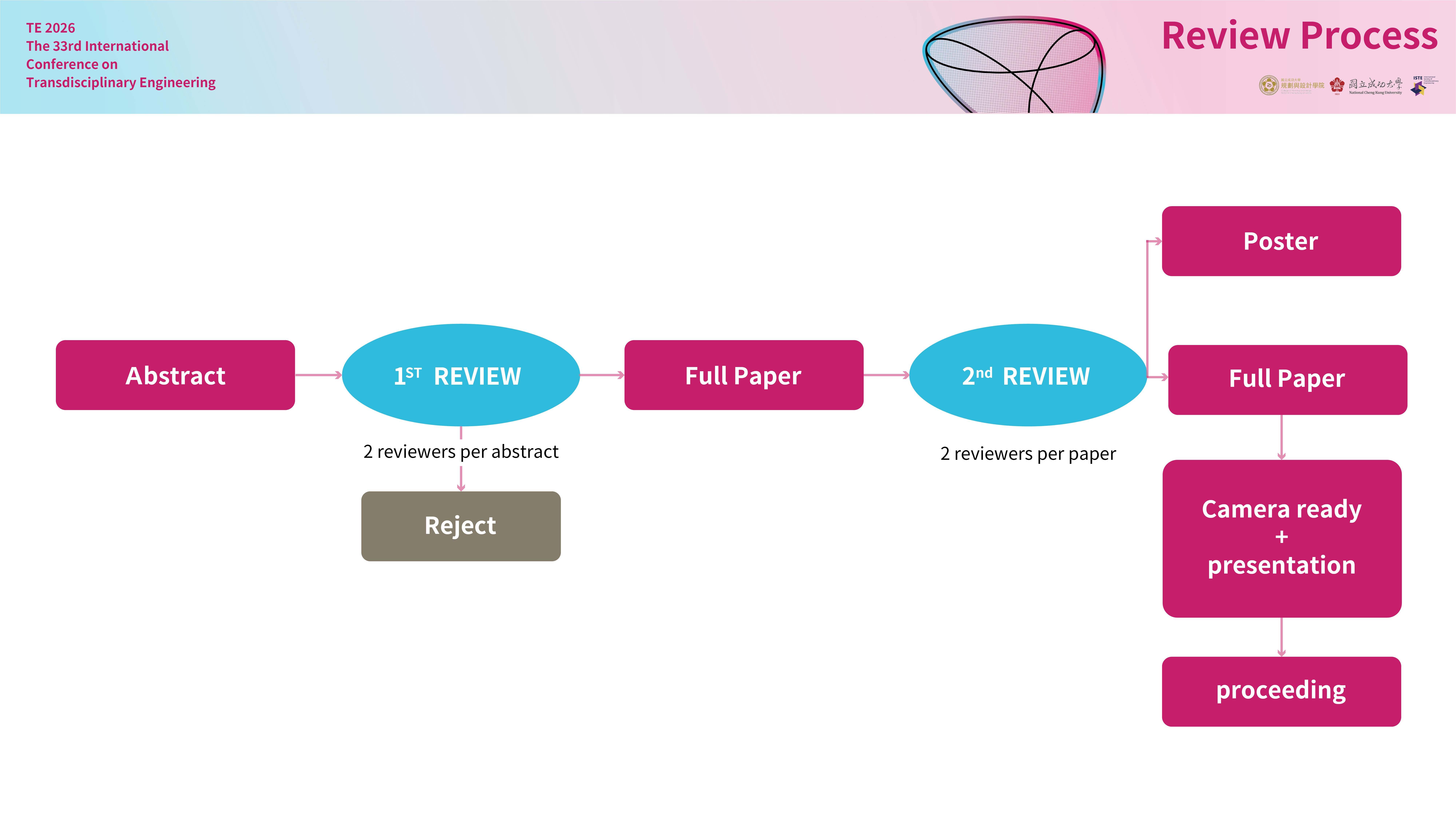
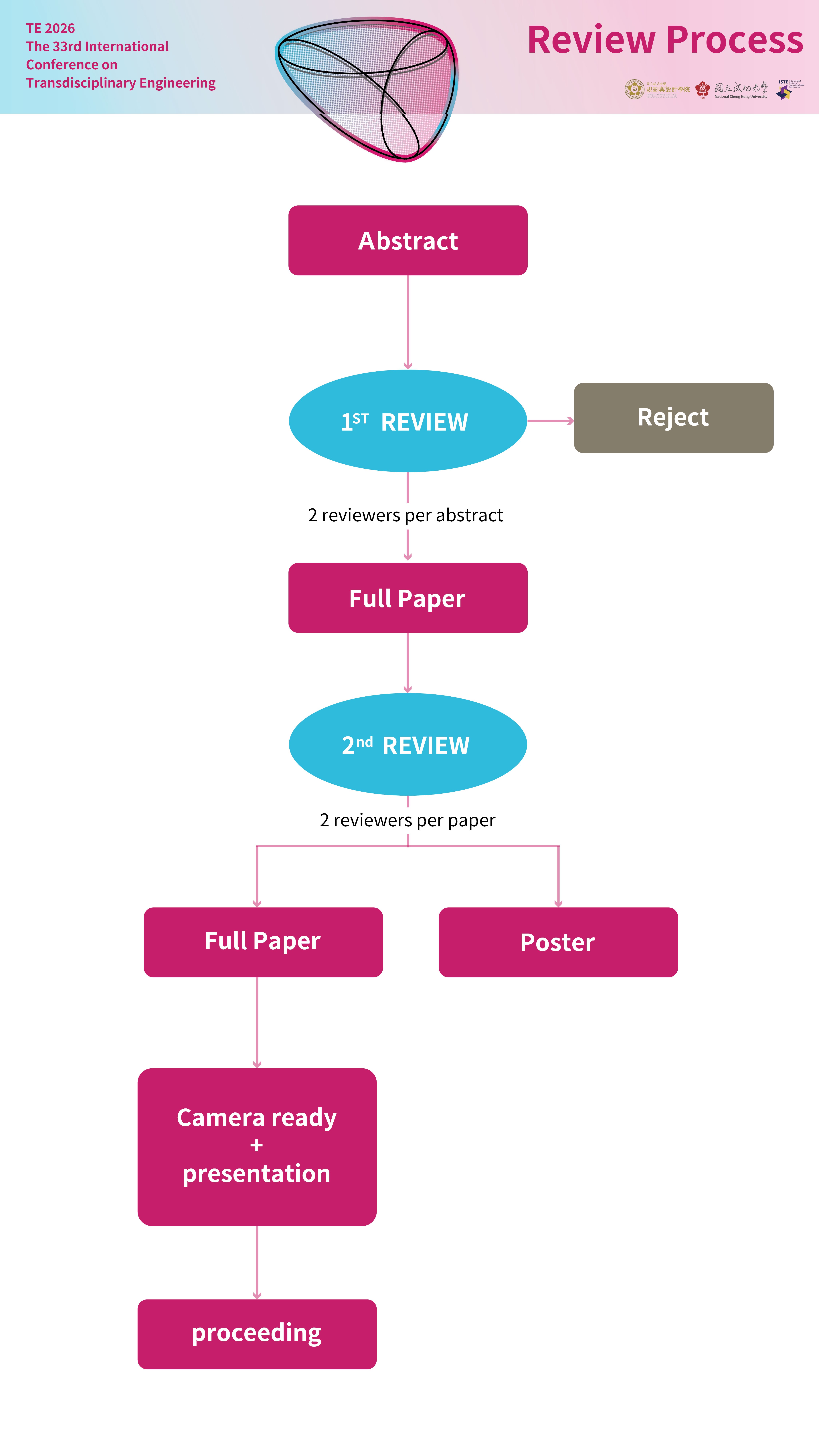
To ensure a transparent and rigorous evaluation, the review is organized into six key stages:
Abstract Submission
Authors submit an abstract of no more than 300 words, summarizing the research objectives, methods, and contributions.
Initial Screening
Each abstract receives a preliminary check by 2 meta reviewers to confirm alignment with Transdisciplinary Engineering (TE).
Full Paper Invitation
Submissions that pass the initial screening will receive an official invitation to submit a full paper.
Full Paper Review
Full papers undergo double-blind peer review. Each paper is independently evaluated by at least two domain experts, ensuring fairness and academic rigor.
Review Decision
Based on reviewer comments and scores, each paper will be classified as:
Accept – Accepted for oral presentation.
Accept as Poster – Valuable contribution recommended for presentation in the poster session.
Reject – Does not meet the conference’s academic or thematic standards.
Camera-Ready Submission
Accepted authors revise their papers per reviewer feedback and submit the final camera-ready version that complies with the publisher’s formatting guidelines.
Review Quality Assurance
Commitment to Double-Blind Review
We uphold fairness and objectivity through a double-blind process, ensuring that evaluations focus solely on scholarly merit.
Author Responsibility for Formatting
Authors are fully responsible for ensuring that their camera-ready papers strictly follow the publisher’s template. The conference does not provide proofreading or formatting services. Any manuscript returned by the publisher for formatting issues remains the author’s responsibility.
Poster Presentations
While many posters originate from papers recommended for this format during review, the conference also welcomes direct poster submissions from students. This initiative encourages broader local academic participation and supports the development of emerging researchers. The poster track offers an inclusive, interactive venue for sharing early-stage ideas, receiving constructive feedback, and engaging with the transdisciplinary engineering community.
How are the best papers selected in TE2026
Nomination of Candidates
The TE2026 Conference Chair selected the top three candidates in each category—Academic, Student, and Industry—based on the highest initial review scores. Papers with a first or corresponding author who is an ISTE board member were excluded. The final candidate list was confirmed by the ISTE President, the TE2026 Chair, and the TE2027 Program Chair.
Confirmation of Attendance
The TE2026 Chair contacted the nominated authors to confirm their registration and attendance at the gala dinner.
Anonymized Paper Preparation
The TE2027 Program Chair prepared anonymized versions of all candidate papers across the three award categories.
Reviewer Invitations
a. The TE2027 Program Chair sent review invitations to TE2026 meta-reviewers (as recommended by the TE2026 Chair) and CC’d the TE2026 Chair. If they agreed to participate, the anonymous paper links were shared with them.
b. Additional invitations were sent to members of the ISTE Scientific Committees (as listed on their websites), also CC’ing the TE2026 Chair. Reviewers who accepted received the anonymized papers.
Scoring and Result Sharing
Once at least three reviewers were confirmed per category, the TE2027 Program Chair calculated the final scores using a weighted system (1st place = 10 points, 2nd = 6 points, 3rd = 2 points). The results were then shared with the TE2026/TE2027 Conference Chairs.